Plant Disease Detection Agent
The Plant Disease Detection Agent is designed to analyze images of plants to identify and classify potential diseases. This task-specific agent plays a critical role in agricultural applications by enabling early detection of plant diseases, helping farmers take timely actions to prevent further spread and loss of crops.
Overview of Plant Disease Detection
The agent uses advanced deep learning models to process images of plants, detect symptoms of diseases, and classify the diseases based on known plant disease datasets. It helps in identifying various plant diseases from the visual symptoms presented on the plant’s leaves, stems, and other parts.
Functionality
Input: The agent receives images of plants, typically taken with a camera or mobile device.
Processing: It processes the images using a pre-trained or fine-tuned deep learning model such as a Convolutional Neural Network (CNN).
Output: The agent classifies whether the plant is healthy or affected by a specific disease. In the case of disease detection, it also provides the type of disease affecting the plant.
Use Case
Plant disease detection can significantly reduce crop loss by enabling farmers to detect diseases at an early stage. Timely intervention and treatment can prevent the spread of disease to other plants and optimize agricultural productivity.
Architecture
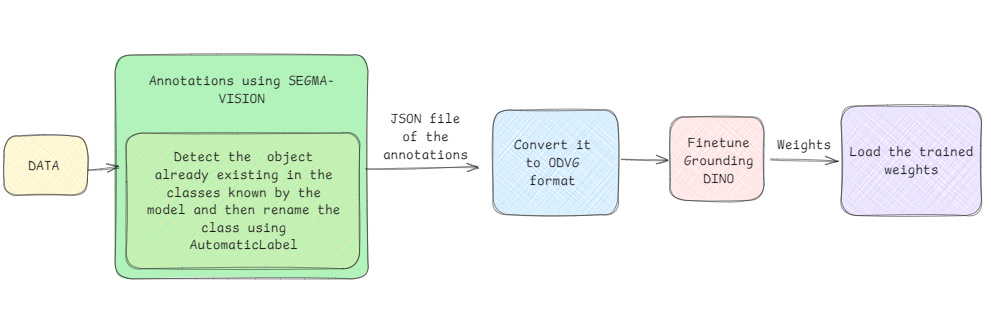
The architecture of the Plant Disease Detection Agent follows a modular deep learning approach, where the fine-tuning process adapts a pre-trained model to recognize specific plant diseases. The process includes: - Image preprocessing to ensure input images are in the required format. - Fine-tuning a pre-trained model such as GroundingDINO on plant disease datasets like PlantVillage and PlantDoc. - Using the fine-tuned model for prediction and classification.
Below is a high-level architecture diagram of the Plant Disease Detection system:
Fine-Tuning the Model
The fine-tuning process involves adapting a pre-trained deep learning model to the specific task of plant disease detection. The GroundingDINO model, initially pre-trained on general datasets, was fine-tuned using the PlantVillage and PlantDoc datasets. These datasets contain images of healthy and diseased plants across various species, making them ideal for training models to detect plant diseases.
Colab Notebook for Fine-Tuning
The fine-tuning of the model was conducted in a Google Colab notebook. The notebook demonstrates the step-by-step process of preparing the dataset, adjusting the model architecture, training the model, and saving the fine-tuned weights for later use.
You can access the notebook used for fine-tuning the GroundingDINO model on plant diseases here:
Colab Notebook Link: Plant Disease Fine-Tuning Notebook
In this notebook, we:
Load and preprocess the PlantVillage and PlantDoc datasets.
Fine-tune the model using the datasets to detect diseases such as Powdery Mildew, Rust, and Blight.
Save the fine-tuned model weights for deployment in the Plant Disease Detection Agent.
Integration with Segma-Vision
The fine-tuned model is integrated into the Segma-Vision Agriculture project. The Plant Disease Detection Agent is invoked by the Coordinator Agent when the user’s query specifies a need for plant disease identification. The agent processes the image, predicts the disease, and returns the results to the user.
Here’s an overview of how the Plant Disease Detection Agent is integrated into the Segma-Vision workflow:
The Input Agent determines the task based on user input (e.g., “Analyze this plant for diseases”).
The Coordinator Agent routes the task to the appropriate agent (in this case, the Plant Disease Detection Agent).
The Plant Disease Detection Agent receives the image, runs the fine-tuned model, and classifies the plant’s condition.
The result is returned to the user with the classification of the plant’s disease or a message indicating it is healthy.
Code Overview
Here is the code for the Plant Disease Detection Agent:
from plant_disease_agent import plant_disease_detection

def plant_disease_detection(image_path):
    """
    This function processes the image and predicts the plant's disease.
    """
    # Load the fine-tuned model
    model = load_finetuned_model()

    # Preprocess the image
    image = preprocess_image(image_path)

    # Predict the disease
    prediction = model.predict(image)

    # Return the predicted disease
    return prediction

def load_finetuned_model():
    """
    Loads the fine-tuned GroundingDINO model for plant disease detection.
    """
    model_path = "path_to_finetuned_model"
    model = load_model(model_path)
    return model

def preprocess_image(image_path):
    """
    Preprocesses the image for the model input (e.g., resizing, normalization).
    """
    image = load_image(image_path)
    image = resize_image(image, target_size=(224, 224))  # Example size
    image = normalize_image(image)
    return image
This agent integrates seamlessly into the Segma-Vision Agriculture multi-agent system, providing a crucial service for plant disease identification and helping optimize agricultural practices through early detection of plant diseases.
See the Segma-Vision integration documentation for further details on the architecture and system flow.
For more information, check out the Segma-Vision Notebook: Segma-Vision Notebook